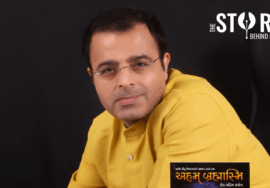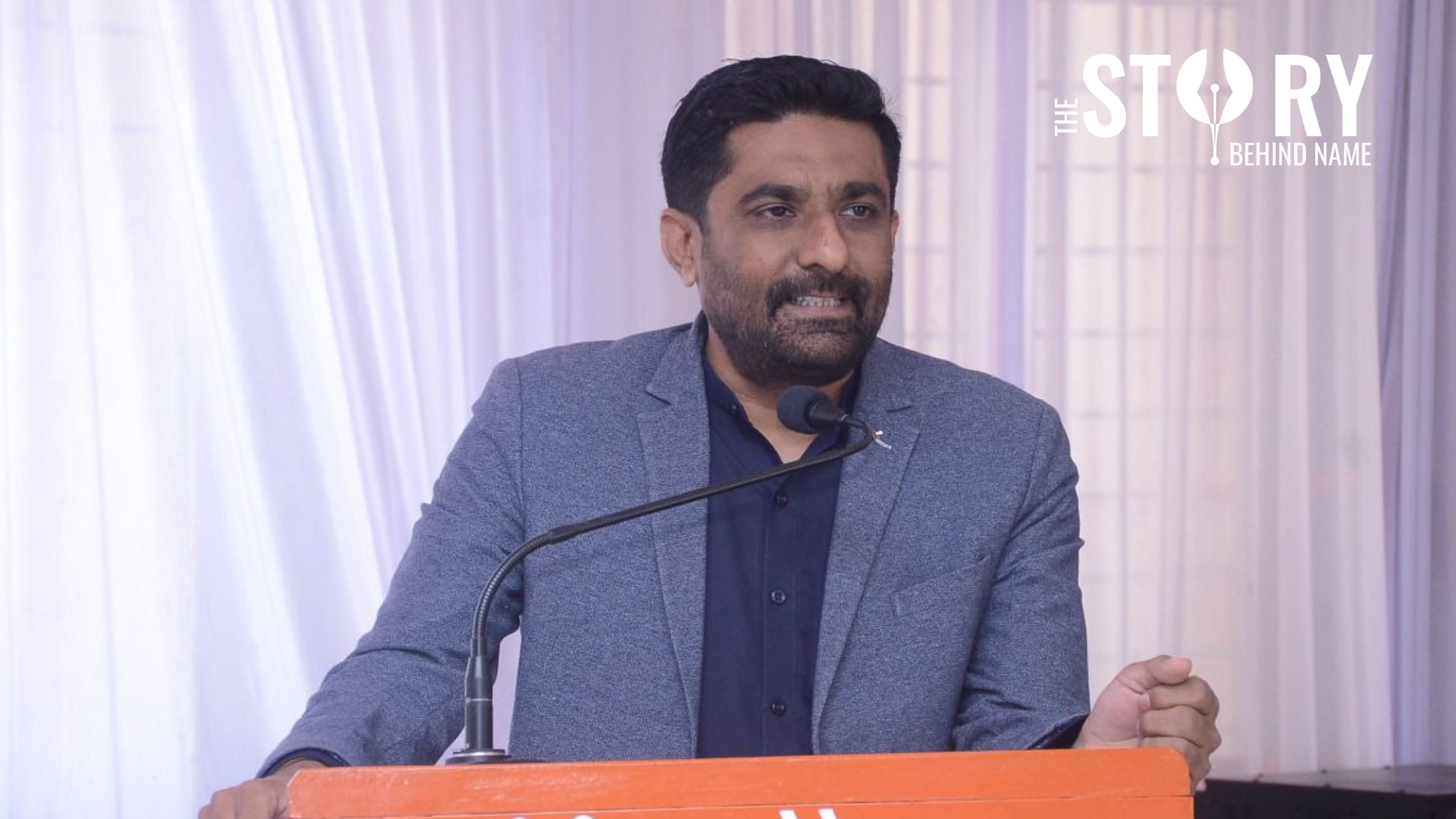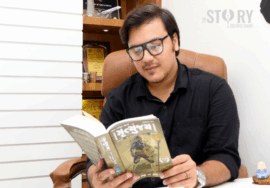

The lionhearted journey of Aashu Patel
Ashwinkumar khant (Aashu Patel) born in the year 1968, his father Mr. Ravji Khant was a farmer and mother – Mrs. Savita Khant a homemaker. He has four siblings – three sisters and an elder brother. Aashu was raised in a modest farming household in a small Gujarati village in the Jamnagar district. He has also worked in the fields with his father.

As a young child, Aashu used to recite the Mahabharata and the Ramayana to his grandfather. Despite not having a formal education, his grandpa and father used to tell him tales that he can still recall.
A saint named Haridas Bapu resided not far from his village, so Aashu spent time with him and visited him frequently at his place. Haridas was wealthy but gave up his money to adopt a saintly lifestyle. Aashu was mesmerized by the fact that he used to sing bhajans and folk songs rich in life teachings. Another beautiful memory that Aashu carry is the old folktales that Haridas Bapu used to narrate. These folktales had an effect on Aashu’s impressionable mind and it became an encounter that will never be forgotten.
Journey Of Becoming A Journalist-Writer.
Initially Aashu used to work in a small store operated by his family in a village where they sold all the necessities. He had also attempted to become a magician during this period. Patel’s elder brother brought all the books at their store after learning that the local library had closed. His brother set them up in a nook and started a lending library out of the store. Aashu’s love for knowledge encouraged him to read all of those novels cover to cover. So, he couldn’t quit reading after he had read so much and consumed this much information that only helped him grow in life. Aashu started sending letters to well-known publications and famous individuals. In this process, he once sent a letter with recommendations for how Rajiv Gandhi should manage the country when he was just teenager. He felt inspired when he received reply that his suggestions would be considered.
He addressed Kanti Bhatt, a respected Gujarati journalist, a letter in 1986. Kanti founded a magazine named ‘Abhiyaan’ with Gujarati journalist Sheela Bhatt, publishers Avinash Parekh and Ketan Sanghvi. Fortunately, he replied to Aashu’s letter and gave him the opportunity to work under him as a writer. However, Aashu was only in eleventh grade of school and when he departed for Mumbai after speaking to his family, he only had 350 rupees to support his dreams.
Kanti Bhatt was surprised to learn that Aashu was only 18 and still in high school when they first met. He instructed him to finish it first and then return. Kanti believed it was absurd for Aashu to travel to Mumbai in that manner. Luckily, Hasmukh Barot, the executive editor of Abhiyaan, also happened to be there. He called Aashu to the magazine’s office at eight at night to meet Sheela Bhatt. Moving ahead, when he met her, she asked him if he knew the headline of that day’s newspaper, and unfortunately, he was unaware of that. But not every time the stars are aligned against you and that’s what happened with Aashu. Thankfully Hasmukh Barot tried taking his stance and asked Sheela to give him a chance to prove himself. Before he realized it, she accepted his application to be an apprentice. However, with this opportunity came a condition; Aashu had to prove himself in a month or he had to leave the publication.
Initial days struggle to health challenges
Aashu Patel spent a very brief time living with his cousin’s sister when he first moved to Mumbai. Even though his sister insisted on extending his stay with them, he decided it was time to leave and live independently. Aashu started as an apprentice, and the salary. He was receiving at the time was insufficient for him to be able to manage a home. After work hours, he used to leave his bag at office at the Abhiyaan magazine and take Mumbai’s local trains to the last station. The big struggle was that his hours were spent doing back-and-forth travel through local trains. Not only this, he has also slept on the benches at Mumbai’s Virar Railway Station for several evenings.
With this cycle of life, he faced the repercussions too as his intestines were severely damaged due to inconsistent sleep and inadequate nutrition. Patel used to disregard the stomach pains that he frequently experienced. The discomfort increased over the course of two to three years. Aashu Patel’s condition worsened because doctors couldn’t figure out what was causing the discomfort and narrow it down. Over the time his intestines were severely infected when they could identify the issue, necessitating major surgery to remove them. It had turned into a life-or-death situation. At a very young age he had to lose a sizable portion of his intestines amputated at an early age, and he says that he still feels its effects daily.
Aashu Patel’s Unforgettable Memory As A Reporter.
Among many stories, this memory is the one that really stayed with Aashu Patel. In don Gawli’s home, the Mumbai cops killed three snipers from the infamous Arun Gawli gang. When Aashu Patel arrived at the location for reporting, the blood on the floor contacted his shoes. He remembers this day vividly enough to never forget it. The moment he got back home, he had to wash his blood-stained shoes.
His First Journalistic Experience
According to Aashu Patel it was the most gratifying experience to get a job in the city of dream, Mumbai. He was instructed to call Kanti Bhatt at eight every morning, and he would assign Aashu Patel any task he had. He told Aashu Patel to prepare a bag of clothes and head to the domestic airport in Mumbai the day after he started as a trainee. There, he had a meeting to attend. When he arrived at the airport, he learned that a group of journalists would be flying on a specially chartered aircraft to Jaunpur, Uttar Pradesh, to cover the opening of the Aga Khan Hospital. Before that day, he had never taken a flight, chartered plane in itself was a whole new experience.
Aashu Patel went to Jaunpur for three days, returned, and composed a 15-page report. Kanti Bhatt tore it to pieces after Aashu Patel handed it to him, and he tore it into the pieces and threw it away. So, it’s fair to say that his first learning was to always keep the reader in mind when writing an article.
Aashu Patel’s Journey from Journalistic Writing to Films
Once, Patel was recovering from jet lag after returning from the United States, a friend named Vivek Vaidya phoned and said that Jituji wanted to meet him. However, Aashu Patel assumed he was referring to a mutual friend buddy, so he requested an extension of the meeting because he was extremely worn out. Vivek then informed him that he was referring to Jitendra, a famous actor. Ekta Kapoor wanted to create a film about the underworld at that time. Till then Aashu Patel had already done a significant amount of study on organized crime and was also penning a Gujarat Samachar column called “The Don.” Moving ahead, director Tigmanshu Dhulia was presented to him by Jituji.
Even though that movie was shelved, Tigmanshu Dhulia and Aashu Patel continued to be close friends. Later, he received an invitation from Jituji to serve as a screenplay consultant for the movie “Once Upon A Time In Mumbai.” That was the start of Aashu’s involvement with the film industry. Currently, Tigmanshu Dhulia is adapting his novel “Madam X” into a motion picture.
A Heartbreaking Memory
Over the years of experience in Aashu Patel’s life a number of things have occurred that have brought tears to him eyes. Many police officers became his pals as a result of his several years of work in the criminal journalism field. Vijay Salaskar, a specialist in encounters, was one of these pals. They spoke on call in 2008 and agreed to meet the following day since it had been a while since they met and caught up on things. That evening, a friend phoned Aashu Patel to inform him that Vijay Salaskar had died in Mumbai’s 26/11 terror attacks. The same day Patel learned that the terror assault claimed the lives of several police officers, including Deputy Police Commissioner Ashok Kamte and the head of Maharashtra’s Anti-Terrorism Squad, Hemant Karkare. Patel was not only upset by this incident, but he was also enraged.
Journey with many mile-stone achievements
Today, he is recognized as an inspiration to countless readers, in addition to being noted for his firebrand writing and being the first writer to write thoroughly about the Mumbai underworld. He is a versatile author who has written more than 55 books in an array of genres, including crime, fiction, inspirational, suspense, and non-fiction. Two English versions his books have been released as well. The writer and Gujarati journalist, Aashu Patel is a man of extraordinary courage to bring out truths.
In September 2004 and October 2005, the governments of the United States and Macau had each extended invitations to him as guests. Not only this, but also Director Tigmanshu Dhulia will soon adapt his novel “Madam X” for the big screen as it has been translated into English.
His Upcoming Project
Aashu Patel has numerous tasks in progress as he spent four years studying for upcoming English novel. His underworld-focused documentary novel, “Once Upon A Time,” will also shortly be published on the well-known Gujarati website. Not only this, but our favourite creative writer and journalist is also writing a book for the Gujarati newspaper Mumbai Samachar.
Writing needs passion and patience not perfect platforms
When asked if he needs a certain kind of environment to write or if uses a special kind of pen to write, patel said that he uses any pen that is in front of him on his writing table irrespective of the price of the pen. Similarly, he continued, he can write anywhere. He has written in a variety of settings, including a crematorium in front of a blazing funeral pyre, on a plane, in a train, in a hospital while his critically ill buddy slept, and in many other places.